Free: work one full practice case, no account needed. Try it →
FHG University · for help desk, desktop and MSP technicians

Operational IT mastery,
structured to completion — with a real outcome to show for it.

The hard part of a certification isn’t the material — it’s finishing. So that is what this is designed around: 8 tracks broken into sections you can actually complete, ranks that mark where you really are, and a résumé that builds itself from the modules you finish rather than from what you claim. Of the 180 modules, 138 map to a published certification objective.

The free case needs no account. Membership is $25 a month, cancel any time.

Or read one complete module first, no account needed → Already a member? Sign in →

Inside FHG University

Practice a real ticket from both sides of the network

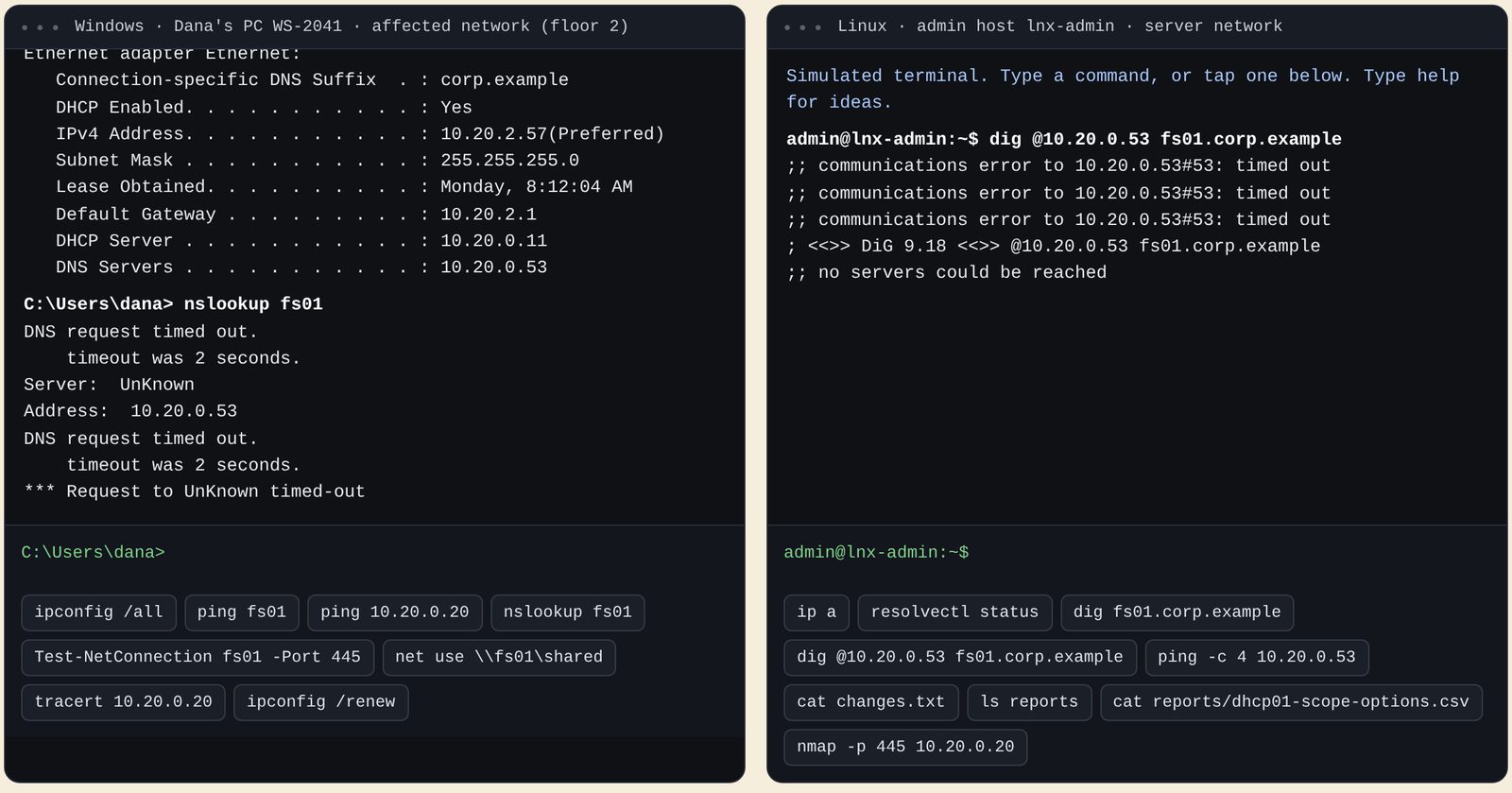
A simulated Windows PC on the affected floor and a Linux host in the server room. Run the checks, find what the evidence supports, write the handoff, then verify the fix from the machine that was broken.

The FHG University practice console: a Windows PC and a Linux host side by side, with ipconfig, nslookup and dig output from a simulated outage, and the commands each terminal understands.
The free practice case: a file share that won’t open on the second floor. Simulated terminals; nothing you type is sent.
Try the free case →
Not Sure Where You'd Fit?

Three minutes. It tells you which track matches how you already work — free, no account.

Take the assessment → Read a full module first →
New to IT?

Start with the IT Foundations track. It is written for someone with no IT background.

See IT Foundations →

FHG Compass is the separate path for ages 13 to 18. Enrollment is paused.

How It Works

The Operator's Path

01

Learn

Work through your track one section at a time, each with a clear finish line.

The eight tracks →
02

Prove

XP, ranks, and badges earned from the modules and labs you complete — a record of the work you record.

The rank ladder →
03

Position

A resume compiled from what you’ve marked complete, mapped to the job titles and certifications listed for each track.

Career outcomes →
04

Land

ATS Check and Interview Prep built from your own record — never a claim you didn't earn.

Start today →
The Arc

Who you become, then what you do, then what you have.

Inverted from the usual order on purpose. Most training starts with the doing and hopes an identity follows. It rarely does — which is why so many people finish a course and still don’t call themselves the thing.

After the modules

The work between finishing and getting hired.

The gap between finishing a course and getting hired is where people actually fall out — and it is the part of this platform you cannot buy more hours of video to fix. These are included at the one price, not held back for an upgrade tier.

01

Career Navigation

Reads real, current openings and matches them against what you have actually completed — plus any résumé you have added and the work history you told us about.

Not a percentage. It names which requirements you have evidence for and which you do not, so you know whether to apply today or finish two more modules first.

02

ATS Check

Paste a résumé. It reports what a parser actually recovers from it, and where your own contribution is left unclear — with no score you cannot trace back to a specific line.

It does not score your résumé for fit with a specific job posting. Reading a posting against your own history is a skill the curriculum teaches you to do yourself, because that is the part that transfers to every application.

Nothing you paste is stored. That résumé is yours.

03

Interview preparation

Questions built from the modules and labs you finished and the experience you actually have — so you rehearse your own evidence rather than generic answers.

The lab questions come from the rubric rather than the title. “Why does session revocation come before the password reset” cannot be answered by somebody who did not think about it.

04

A résumé that compiles itself

Built from completed modules and labs actually run. It lists only what you record as finished, so every line on it traces to a module you marked complete or a lab you recorded.

That gap is the most expensive thing anybody carries into an interview.

What none of this does is get you hired. It surfaces the evidence you already have and names the gaps you do not. No placement rate, no salary figure and no timeline appears anywhere on this site — our build fails if somebody tries to add one.

Why every evidence tool is included: you own what you can prove

A certification is rented. It expires, it gets superseded, and the body that issued it decides when — not you. There is a credential on our own map that retires in February 2027 and there is nothing anybody can do about that except know it in advance.

What you own is the evidence. The labs you ran. The modules you finished. The diagnostic log you wrote working four faults at once on an inherited network. That is permanent, it is portable, and no vendor can switch it off.

Which is why this platform works the way it does. Your résumé compiles itself from what you finished rather than from what you claim. What you write in a lab is your own document, and it stays yours if you cancel. Career Navigation names which requirements you have evidence for and which you do not, because a percentage is not evidence. And the certification map tells you which credentials expire and when — a rented thing has an expiry date, and the person paying for it should be the first to know.

It is also why none of the evidence tools are an upgrade. Career Navigation, ATS Check, Interview Prep and the résumé builder are all included at the one price. The tools produce your evidence. Holding those back to sell a higher tier would contradict the entire idea, so there is no higher tier.

The Curriculum

Eight tracks. Real content.

One of them was teaching AI security before Microsoft made it an exam domain. Copilot risk, agentic AI governance and AI red-teaming have been in the Identity track since it was written — Microsoft’s first security exam to formally test any of it was released in May 2026.

Not hypothetical curriculum — 180 modules, built around real certifications and the skills the roles actually ask for, sequenced with a clear finish line.

Read the full background →

The curriculum
180
modules; 138 mapped to a published exam objective
The paths
8
tracks, from help desk to the senior security tier
The map
25
certifications listed — including the ones we do not cover
The honest number
16
we actually prepare you for. The rest are named.

Every figure here is derived from the curriculum at build time. If one of them were wrong, the build would fail before the page shipped.

And the order matters more than people are told. Entry-level security hiring is hard right now — many organizations that report a shortage made no junior security hires at all last year. The route that works is support first, then the specialist track: help desk and service management, then endpoints or infrastructure, then security. Every track below names the roles it actually leads toward, in that order.

🧭

IT Foundations

Start here

Written for someone with no IT background: how computers count, how software gets built, networks, security and data, then hardware, operating systems, troubleshooting and networking. Leads toward: CompTIA Tech+, then A+, then Network+ — the entry ladder, in that order.

26 Modules
Prepares you for: CompTIA Tech+, A+ & Network+
What’s inside
Includes: How Computers Count — Binary, Hex, and Why It Matters, Real Troubleshooting — A Method, Not a Guess, IP Addresses & Subnets — How Devices Actually Find Each Other
Levels: Foundational
Foundational: Software & Code, Systems, Security & Data, Hardware & Operating Systems, Troubleshooting, Security & Professionalism, Networking Foundations
💰

MSP & Financial Governance

ITIL 4 service management and the audit methodology behind FHG's own MSP practice. Leads toward: Help Desk Analyst, IT Support Specialist — the most common first IT job there is.

15 Modules · ~12.4 hours
Prepares you for: ITIL 4 Foundation
What’s inside
Includes: The MSP Audit Blueprint (50-Point Forensic Checklist), FinOps for MSPs, Value-Based MSP Pricing Models (Capstone)
Levels: Foundational → Core → Specialist
Foundational: ITIL 4 Core & Guiding Principles · Core: Service Management Practices, Exam Readiness · Specialist: MSP Business Practice
🖥️

Device Management

Intune, Autopilot, Windows 365, Entra device identity, endpoint security and Intune automation — setup to governance. Leads toward: Desktop Support Technician, Desktop Support Analyst.

20 Modules · ~15.4 hours
Prepares you for: MD-102 (Endpoint Administrator)
What’s inside
Includes: The 48-Hour Intune Setup Guide, The Privacy-First BYOD Blueprint, Enterprise Device Governance Audit (Capstone)
Levels: Foundational → Core → Advanced
Foundational: Provisioning & Cloud PC · Core: Device Identity & Configuration, Multi-Platform & BYOD · Advanced: Endpoint Security & Compliance, Lifecycle, Analytics & Automation
🔌

Network Foundations

Routing, switching, VLANs, spanning tree, OSPF and wireless — the networking depth the other tracks assume you already have. Leads toward: Network Technician, NOC Analyst, Junior Network Engineer.

6 Modules · ~6.1 hours
Prepares you for: Cisco CCNA (200-301 v1.1)
Built against blueprint v1.1. The last day to test on v1.1 is 2 February 2027; v2.0 testing starts 3 February and restructures every domain. FHG is updating this track to v2.0 before then, and your membership includes the updated modules, with nothing to repurchase.
What’s inside
Includes: IP Connectivity: Routing Tables, Static Routes and OSPF, Network Access: VLANs, Trunking, Spanning Tree and Wireless
Levels: Foundational → Core → Advanced
Foundational: Network Fundamentals · Core: Network Access, IP Connectivity · Advanced: Security Fundamentals, IP Services, Automation
Flagship Track
🏗️

Infrastructure

Two clouds, not one. Core administration taught on Azure, then the same concepts on AWS — plus VMware exit strategy, hybrid cloud, Kubernetes storage & networking, IaC and SRE fundamentals. Every cloud module names its counterpart on the other platform, because employers hire for the idea, not the console. Leads toward: Junior Systems Administrator, NOC Technician, Data Center Technician.

38 Modules · ~31.7 hours
Prepares you for: AZ-900, AZ-104 & CKA
What’s inside
Includes: The AWS Service Landscape, AWS Security & Compliance, The Well-Architected Framework, SRE Incident Response (Capstone)
Levels: Foundational → Core → Advanced → Specialist
Foundational: Azure Core Administration, AWS Practitioner Path · Core: Cloud Cost & Monitoring · Advanced: Migration & Edge, Kubernetes, Reliability & SRE Practice · Specialist: AWS Architect Path
Flagship Track
🛡️

Identity & AI Security

Zero Trust, Copilot readiness, agentic AI governance, threat hunting, cloud/container security and AI red-teaming. Leads toward: SOC Analyst, Security Operations Analyst — the cleared-work track.

44 Modules · ~36.3 hours
Prepares you for: SC-900, Security+, SC-300, CySA+ & CompTIA SecAI+
Microsoft’s SC-500 (May 2026) tests an AI-security domain these modules already cover — though SC-500 also tests Microsoft product configuration this track does not.
What’s inside
Includes: The Zero Trust Roadmap for M365, The Agentic AI Governance Playbook, Zero Trust Infrastructure for Small Enterprises (Capstone)
Levels: Foundational → Core → Advanced → Specialist
Foundational: Security Foundations · Core: Identity & Access Management, Security Architecture · Advanced: Security Operations, Resilience, DevSecOps & Reporting, SIEM & Response · Specialist: AI Security & Governance, Security Leadership
⚙️

IT Automation

Power Automate, PowerShell, Bash/Python, Terraform, CI/CD and Linux administration — first workflow to full pipeline. Leads toward: Automation Engineer I, RPA Engineer.

21 Modules · ~16.6 hours
Prepares you for: CompTIA AutoOps+ & Linux+
What’s inside
Includes: Power Automate for IT Managers, PowerShell Core 7: The Ultimate Scripting Guide, Automation Governance Audit (Capstone)
Levels: Foundational → Core → Advanced
Foundational: Workflow Automation, Scripting Foundations · Core: Linux Administration, Configuration Management & IaC · Advanced: CI/CD Pipelines, Delivery Measurement & Pipeline Security
🎯

Getting Hired

The part nobody teaches. How an applicant tracking system actually works and what makes you invisible to it, writing bullets that show evidence instead of duties, claiming a certification you are still studying for in language that survives a background check, reading which requirements in a posting are real, and answering the four questions that decide more outcomes than every technical question combined. Leads toward: the interview you have been getting screened out of.

10 Modules
No exam maps to this — and that is the point
What’s inside
Includes: The Resume That Actually Gets Read, Writing Evidence, Not Duties, Claiming Credentials Without Overclaiming, The Gap, the Pivot, and the Money
Path: The Resume → The Market → The Interview
How progress is measured: Operator Ranks
The Progression System

Operator Ranks

Ranks exist to answer the question every self-taught learner gets stuck on: am I actually ready to apply yet? Each one unlocks at a real completion threshold, so progress is measured against the platform rather than against a percentage bar.

Three things are measured here and they are not the same thing. Your rank tracks how much of the platform you have worked through, across every track. Your percentage in a single track is what decides which job titles Career Navigation shows you — entry titles at a quarter, senior ones at three quarters, because a help desk role genuinely does not require a finished track and a senior one does. And a certification’s tier — foundational, core, specialist, advanced — is the industry’s own ladder, not ours.

They will not line up, and that is correct. You can be well through the platform and early in a track you only just started.

🎖️
Recruit
0 XP
●
Operator
500 XP
●
Senior Operator
1,500 XP
●
Systems Architect
3,500 XP
●
Master Operator
7,000 XP
🛡️
💰
⚙️
🖥️
🏗️

Every certification we prepare you for — and every one we do not — is published in full.
Read one before you decide. One complete module is published in full — no account, no email, no card. Every section, the hands-on lab, and the takeaways, exactly as a subscriber reads it.

New to all of this? If certification names still sound like an alphabet, start with IT Foundations, the first track above. It assumes no IT background and works through Tech+, A+ and Network+ material in that order.

Membership

Simple pricing. Everything included.

Under every major cert-prep platform's standard tier — roughly half of ITPro Premium ($59) and Pluralsight Core Tech ($45), with team seats on those platforms running into the hundreds per person per month. Everything is included; there is no upgrade tier holding the good material back.

FHG University
$25/month
  • Full access to all 8 career tracks — 180 modules
  • XP, rank progression, and badges
  • Resume Builder, ATS Check, and Interview Prep
  • The FHG Graduate credential
  • Cancel anytime — no contract
  • 48-hour money-back guarantee — one click, no conversation
  • FHG Compass included — the student pathway for someone aged 13 to 18 in your household, at no extra cost, once Compass enrollment reopens (it is paused now)
Automatic renewal: $25/month, charged today and on the same day each month until you cancel. No minimum term. Cancel in one click from your account settings at any time; full refund within 48 hours of your first payment. Terms · Refunds · Privacy
Subscribe — $25/mo
Read what this actually costs you in hours before you decide — it is the most honest page here.
Secure checkout via Stripe. Redirects you back here signed in. If the first 48 hours don't show you what you came for, refund yourself from your account — one click, no email, no retention call. You risk 48 hours, not one decision.

What we can actually back

Start with what this does not do

Most training pages open with what they promise. Ours opens with the limits, because those are the part you cannot check after you have paid.

We do not certify anyone

FHG issues no certification of its own. The FHG Graduate credential named in the pricing below is our own record of what you completed here, not a vendor certification. The tracks prepare you toward certifications that CompTIA, Microsoft, AWS, Cisco, CNCF and PeopleCert administer — and the exam fees are theirs, not ours, and are stated before you start.

We do not promise a job

No placement rate, no salary figure, no timeline. What the platform produces is evidence: a résumé built from modules you actually finished, with real done-and-total counts rather than claims.

180 modules, and the number is checked

Eight tracks. Every count on this page is read from the curriculum file, and a guard fails the deploy if the page and the data ever disagree. Nobody here can quietly round up.

Every mapping checked against the vendor

Each of the 138 mapped modules points to a published certification objective in that vendor’s exam guide — and the objectives we do not cover are published too. The counts on this page are checked against the curriculum at every build.

A full module, before you pay

One module is published in full — no account, no email, no card — so you can judge the teaching before you pay anything. The labs open with the subscription: the starter lab is a written procedure for work you already do, completable with no vendor trial that expires into a bill; a practice lab uses your own computer or a supplied scenario; and the other 7 are drawn from real engagements.

Cancel in one click

$25 a month, no minimum term, full refund within 48 hours, and cancellation from your own account settings without a conversation. Your progress is kept if you come back.

Nothing above is a testimonial, because we have none and will not write any. Every line is something you can verify before you spend anything.

Advising, for members

FHG Foundations

90 days of career and technical advising alongside your University membership: written reviews of your own work, your questions answered, and scheduled sessions in a cohort of six. $500, one payment, on top of the $25 membership.

🦁

Who you're becoming, then the work

For adults with a real goal and their own work to improve. You decide where you're going, then every review measures your work against it.

Enrollment is not open yet
See what's included
For Teams & Programs
Institutional Licensing

Built for whoever has to answer for the outcomes.

Workforce boards, community colleges, veteran service organizations and classrooms license FHG University by seat — with the roster management and progress reporting a funder actually asks for.

From $14 / seat / month

At 500+ seats. Teams start at 5 seats, $240 per seat per year, arranged through the inquiry form and a signed order while card checkout is paused.

Roster managementAssign and reclaim seats as participants come and go.
Funder-ready reportingLessons opened, modules completed and tracks in progress, exportable to CSV.
60-day noticeWe send the renewal reminder, not you.
See institutional licensing

Community contribution at 250, 500 and 1,000 seats — to a program, scholarship fund or cause of your choosing.

Coming soon

FHG Anime

An original animated series about the work itself. Each episode puts one real technical decision under pressure, the kind a technician makes on an ordinary shift, and shows what the evidence does and doesn’t support.

🛡️

Starring the Pride

LEO, ED, SCRATCH, APEX and PICKET: the same five characters members choose as their avatars.

In production
“We don't sell hours. We deliver outcomes.”
— The FHG Standard
Get Started

Structured mastery, one track at a time.

Enter the Dashboard